
TERIAAA!! A Behind-the-Scenes Look at the (Re)Making of a Cutscene
December 29 2025
16 min read
For this post, a $50 CAD donation was made to Gender Creative Kids, a Québec-based organization dedicated to support trans, non-binary, and genderfluid youth's affirmation within their communities. This was inspired by my current read, Seahorses: Trans, Nonbinary, and Gender-Expansive Pregnancy, that is a powerful book told from multiple perspectives, each offering a gender-expansive view of parenting and families. To learn more about Gender Creative Kids and the work they do, feel free to visit their website here.
At the beginning of 2019, a good friend of mine, Charlie, asked me if I was interested in being part of a collaboration project. Their friend, Nat, was reaching out to animators and storyboard artists, a lot of whom were already working in a professional capacity, and gathering a group to reboard the cutscenes from Sonic Adventure 2 (or Sonic Adventure 2: Battle, for most people). There were a few other “reboarded/reanimated” projects at that time, and this one would be from a game that was infamous for its cutscene quality. Not only that, but I knew that Charlie (from our own friendship) and Nat (as a fan of her professional and personal illustration projects) were huge fans of the Sonic series. Would I be interested in taking part?
Absolutely. Let’s go.
Live & Learn
Sonic Adventure 2: Battle was the first Sonic game I owned. I played through it and I loved it for a lot of reasons why young teens naturally gravitate towards this stuff. It’s cool in a “shōnen-coded” kind of way, in the sense that it’s about adventure and friendship and drama and Soap shoes. Sonic’s a blue hedgehog! He’s got attitude! The game let you play as the good side… and the dark side! The development team was really trying for something grand and story-heavy here, even amid all the jokes and jank, so I get why this game could leave an impression on an audience. I have warm memories of my time with the game, and I think a lot of it has to do with the cutscenes.
I love the Sonic Adventure 2 cutscenes because there’s a quality to them that's campy as hell. Everyone is so incredibly earnest in their line delivery, the expressions don’t always match up to the audio, and when dialogue awkwardly overlaps it all feels like you’re watching the equivalent of a very amateur film, with all the gaffs left intact. Sometimes the actors talk over each other's lines, sometimes the boom mic floats down into the frame, but hey, that’s all part of the appeal.
It’s charming in its awkwardness and it still manages to hold up because the core of it still kinda works! It works in the sense that it’s just good enough to do what it needs to do to keep the plot rolling. That script, combined with the animation direction, made it more memorable than I expected. My thoughts have always been that if this game ever got a modern team of animators to take another crack at animating those cutscenes, it might turn out to be cool! Cool in the way that teenage me always imagined it to be. And with this collab, in a way, I had a chance to prove it.
Believe In Myself
The big question is: why post about it? Well, I want to talk about the work that I did for this collab because I’m really proud of it! I care about this game, and I care about the many collaborators on the project who I was fortunate enough to work alongside. Especially Nat F who put in so much work spinning this together and supporting everyone over six years! She absolutely needs to be given her flowers for everything she put into that project. I really can’t overstate how much of a talent she is and how dedicated she was to everyone’s individual contributions. A part of me wishes that the whole project came see the light of day in the way that it was intended so that she could get the recognition and respect she rightfully deserves for organizing it. I'm also certain her scenes (PLURAL!) would've been absolutely killer. Y'all weren't ready for it.
And like with any cancelled or infinitely-shelved project, it’s worth talking about what went into it for my own sake and others. It was a cool project, and if circumstances were different and maybe we had one less global health crisis or job crisis to deal with, then maybe this thing could’ve really come together? I don’t know!
But I also want to talk about the process behind making this animatic because for a lot of non-animation game workers, especially at smaller studios, they may not know the real extent of the preproduction work involved. They also may not know the benefits of boarding out work! There is immense value in giving time to plan, thumb, board, or even create animatics for moments that serve as important beats in your narrative games, no matter the animation medium you’re working in. To be clear, not every cutscene will be as elaborate as the one I'll be talking about below, nor will they require the exact treatment I outline here. Most are a lot simpler! This post by Brendon Chung about boarding out scenes in Skin Deep is a good example of the benefits of using storyboards and the motivation that anyone can make them. My hope is simply that, in detailing what goes into preparing a cutscene, that other game workers can learn and better execute their own cutscenes. Or at least be more informed about the work involved! A little bit of forethought goes a long way.
For my part in the collab, I picked cutscene #31: Egg Golem, otherwise known as the “TERIAAAA!” scene. Here's the original cutscene (from the Dark Story side) for reference:
And here's what I made:
I knew I wanted something with a the full cast of Hero characters. And this boss and this arena always stuck out to me when I played it. I thought it’d be fun to board out the fight as well, otherwise the whole scene would end up wrapping up too quickly and I didn’t want to take a super comedic angle for it. I want it to feel tense and fun! Let Sonic and his friends have their personality shine through in their actions, have some dramatic ups and downs, and keep it engaging. How hard can it be?
That’s The Way I Like It
Before the hubris hits, let’s take a look at the original scene and think about what works, what doesn’t, and why. Looking at the script (which was already transcribed for me, a huge boon, thank you Nathalie!) helps us slow down, unpack some lines, and reverse-engineer the writer’s possible intentions. What’s going on here?
INT. PYRAMID INNER CHAMBER - DAY
A door opens. In walk Knuckles, Amy, Rose, and Sonic. Sonic's doing stretches in the background.KNUCKLES
Huh... That was pretty rough.
TAILS
We did it! Let's go, Amy!
AMY
Yeah!
DR. EGGMAN (O.S.)
You little thieves! Did you really
think you could get out of here
alive?AMY
Eh?
From the other side of the chamber, Dr. Eggman walks in. He waves to them.
SONIC
Come and get some, Eggman!
TAILS
Sonic!
Sonic gets ready for a fight.
SONIC
Just leave it to me!
DR. EGGMAN
This time, I'll take your lives as
well as the Chaos Emerald.
I call on you to destroy these
pests. Come out my servant!The chamber rumbles. Suddenly a giant stone hand emerges from the center of the chamber, lifting itself up to reveal a massive EGG GOLEM with a button on its head. It looks down at Sonic menacingly.
DR. EGGMAN
Now go... And squash that blue
hedgehog, Sonic!The Egg Golem winds up to punch. Sonic launches himself at his head, feet first.
SONIC
Ha! Teriaaaaa!
He kicks the button and flips off his head in slow-mo. The Golem gets knocked back, spins its head, and tries to re-orient itself.
DR. EGGMAN
(sotto voce)
When Sonic struck his head he must
have broken the restraining
mechanism!
Arrgh! What a piece of junk!The Egg Golem hears that and turns to Eggman. With a giant hand it reaches out towards Eggman, unable to escape.
DR. EGGMAN
Nooo!
Right off the bat, there’s not much going on here In terms of plot: the gang enters, Eggman traps them, sics a golem at them, Sonic kicks it so hard it scrambles its circuits, and the golem attacks Eggman instead. End scene.
The good news is that the dialogue here is very straightforward, and aside from the clunky explanation at the end by Eggman, it rolls along smoothly with little delay. What’s clear from this script, is that it feels like a scene where the bulk of the work to make it more interesting is going to fall on the storyboard artists and animators, so that’s good for me.
However, it’s not all smooth sailing. I first note that since this scene immediately follows Knuckles’ fight with King Boom Boo, the implication is that defeating that boss was the key to reaching this chamber. So it’s weird to me that Knuckles comments on how “that was pretty rough,” but that Tails then immediately follows with, “We did it!” (emphasis mine). It’s also weird that once the Egg Golem enters, Knuckles, Tails, and Amy disappear from the scene. The Egg Golem only cares about Sonic and no one else intervenes. Why aren’t they fighting too? Since the whole fight isn't playable here, I need to fins a way to justify that. The third problem I notice (which isn’t new to animators or storyboard artists) is that sometimes a script sometimes will try to describe a simple fight scene. But if it was adapted faithfully, the fight wouldn't be interesting to watch. It'd be over too quickly! I need to find a way to make the fight feel dynamic and entertaining, and to think of a natural way for Sonic to finally get the upper hand. I can’t rely on “The Egg Golem winds up to punch. Sonic launches himself at his head, feet first,” to make up the entirety of the scene. That'll be left for the end.
Another thing to note is that since the dialogue for this scene is already recorded, it means that we’re locked in to the timing and delivery of each recorded line, and that we have to listen to each line very closely and think about how they play in succession to get the most out of each delivery. I also have extra recordings and grunts from other scenes to splice in, if needed. The best way to do that is to listen to each track, one by one, and make notes. I usually do this by printing out a copy of the script at half-size in landscape format so that I have room to annotate each page. Here are my notes for this scene:
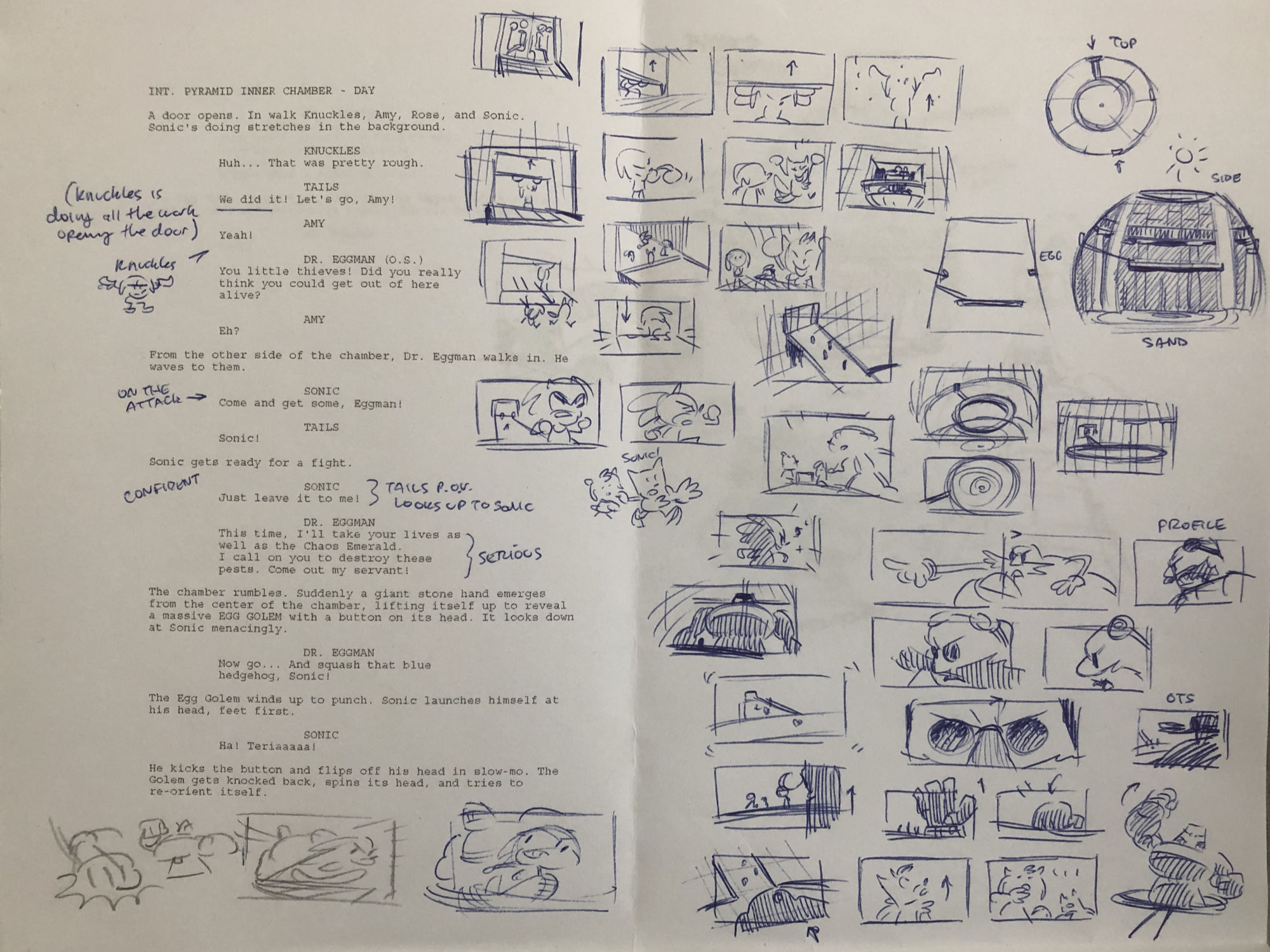
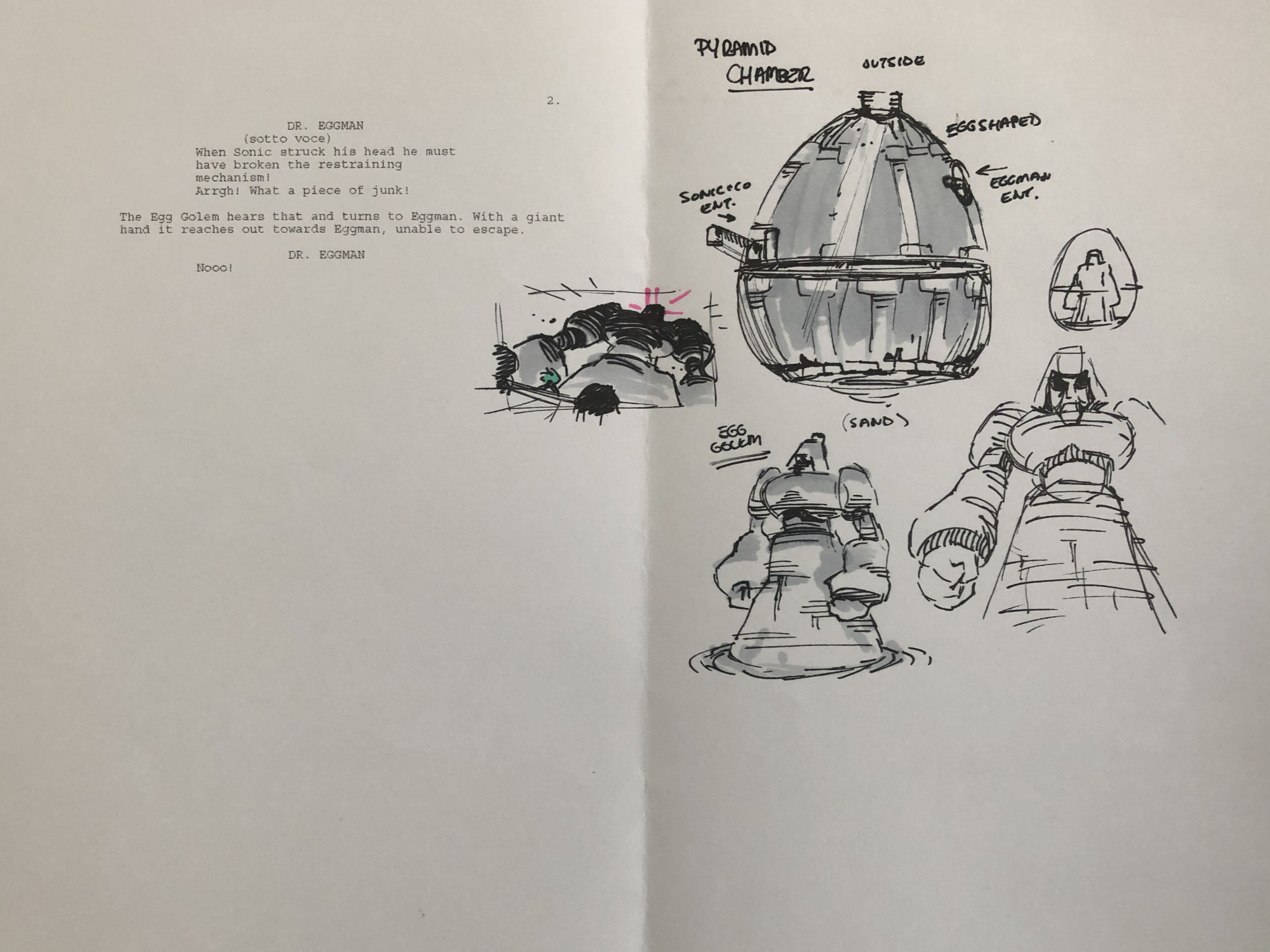
Adding notes this way also lets me jot down thumbnails for shot compositions that come to mind when I read the script. It's a process I picked up storyboarding for 11 minute cartoons and have kept up since (even for the Grapple Dog 2 trailer I worked on with Jellybox). How can I frame certain lines? Would a close-up work better? A wide? How many character should be visible here? I need to establish the location, figure out where everyone is placed, and maintain consistency between shots so that a viewer always knows where everything is relative to each other, especially in scenes involving action or fast cuts!
You can see in my notes I add some comments right away. I think of a gag where Knuckles is lifting a big heavy door and commenting on how it was rough, so that Tails’ comment (“We did it!”) feels like more of an intentional joke, especially one a kid would make. I also make a note that when Tails yells “Sonic!” he is genuinely worried about Sonic, he looks up to him. It could make a nice beat to have Sonic’s response seen from Tails’ POV: how does Tails look up to Sonic? What does Tails see when he sees Sonic? Is he still the hero we believe in? You can see the thumbnail to the bottom right of the doodle of Amy holding back Tails. It’s a nice emotional moment, and it gives us the means to justify why everyone else doesn’t engage in the fight: Sonic’s got a handle on this, and they all believe him. Finally, I make a little note that Eggman’s lines right after that (“This time…”) take on a very serious tone. This dude really wants to kill that hedgehog. Dang.
Now the first big issue starts to solidify in my mind. All the action takes place in one room. Not only that, but it’s egg-shaped. There are no corners. It all takes place, roughly, on a single plane. How the hell am I going to make this visually interesting? And there’s supposed to be a fight in here??
Won’t Stop, Just Go!
Here's an important lesson in film: not every shot needs to be an absolute banger, nor should it. I don't think it makes for an engaging viewing experience. If everything is meant to be incredibly memorable, then everything instantly becomes forgettable. It can’t just be all peaks! Instead, you need to think about your key shots or key moments, really try to nail those, and then find the means to connect them together. All the other shots should be a connective tissue between those keys, and they can be serviceable enough (or follow a grander guiding philosophy for how you want to frame certain moments, characters, or sequences). Figure out what you want viewers to remember, build those moments, and then tie everything together. It’s a similar approach to traditional animation techniques! Set your keyframes, put effort to make sure they read clearly, and then fill the rest with breakdowns and in-betweens.
So following the script review session, and having some thumbnails sketched out (or buzzing around my head), I usually try to get some paper and thumb out the entire sequence, if possible. It’s important to see things in their proper order, tied to lines of dialogue, from start to finish. It makes it much easier to identify areas that need more planning (especially when you need to consider sight lines and the 180 rule), or where something feels weaker relative to everything else. And thumbs don’t have to be fancy! Any will do, as long as they communicate clearly enough what’s in the frame. Here are mine:
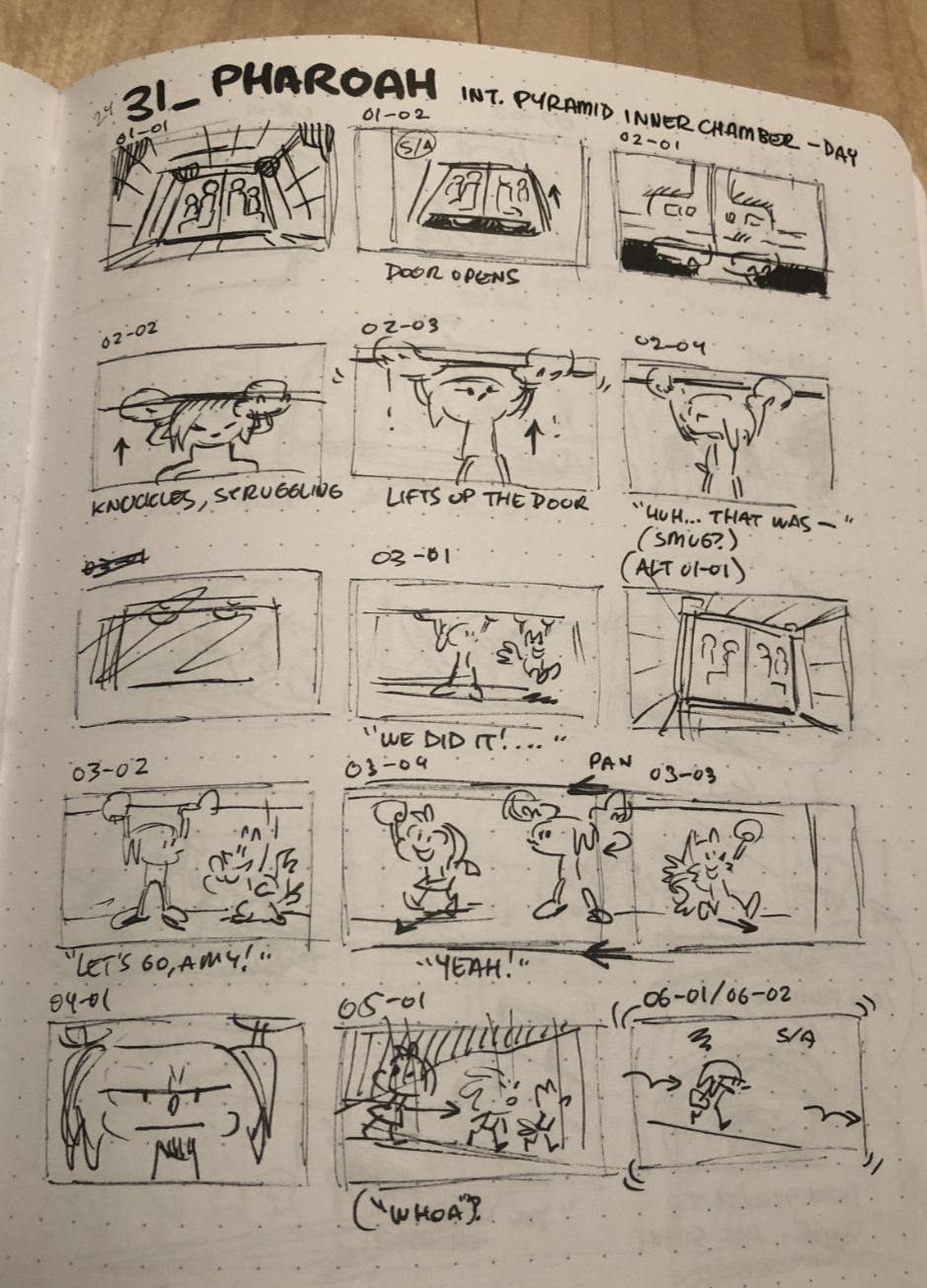
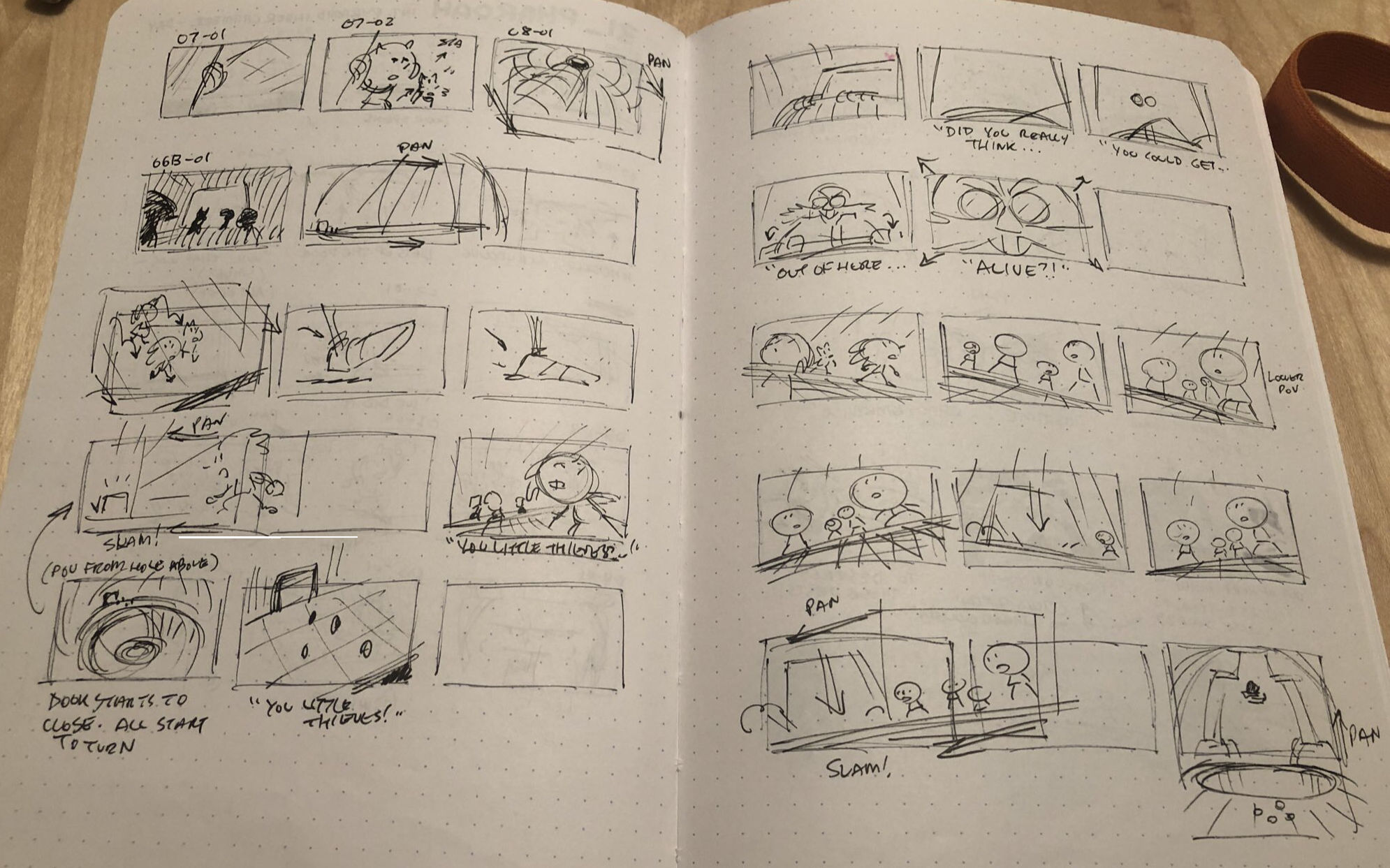
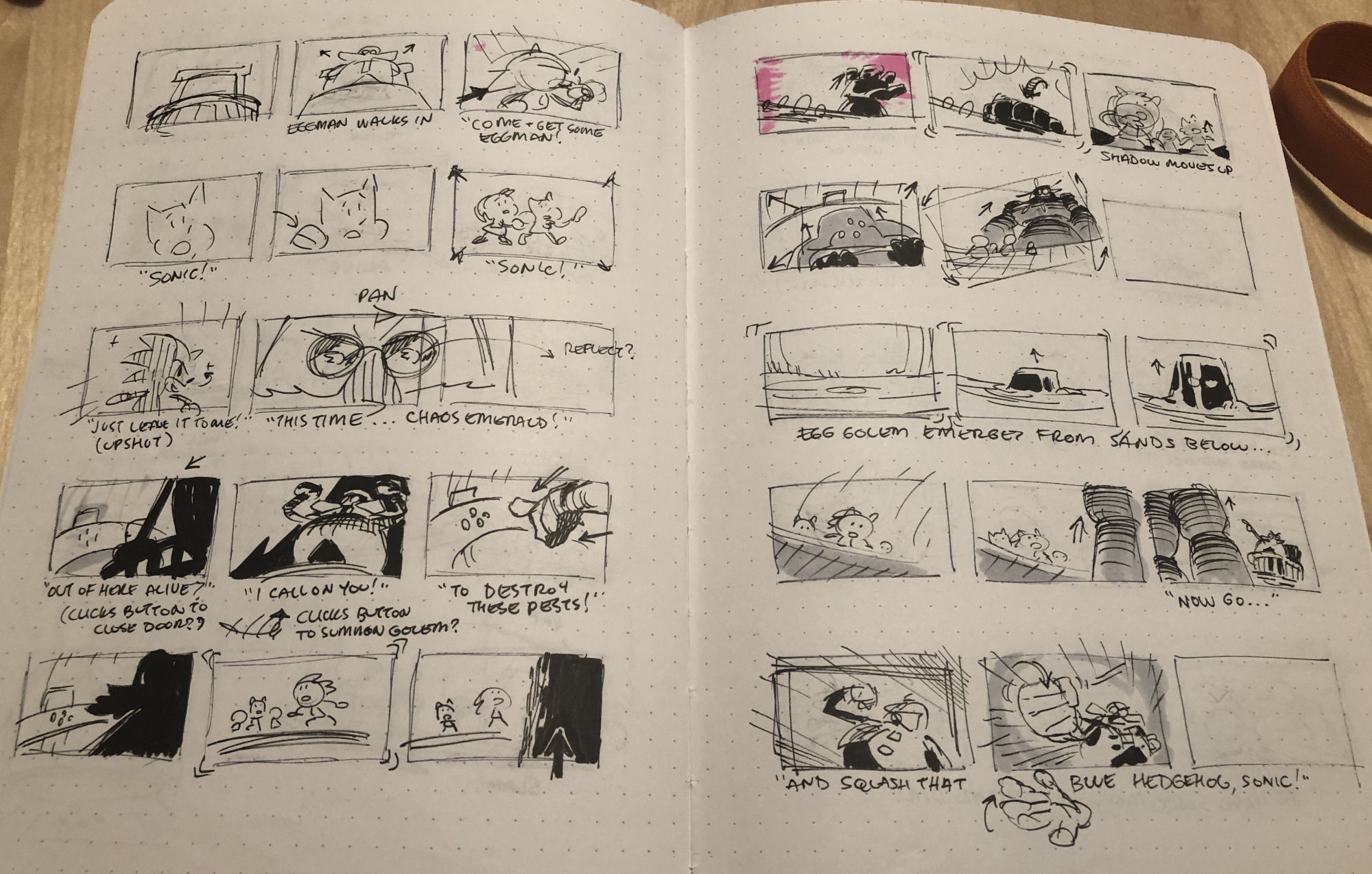
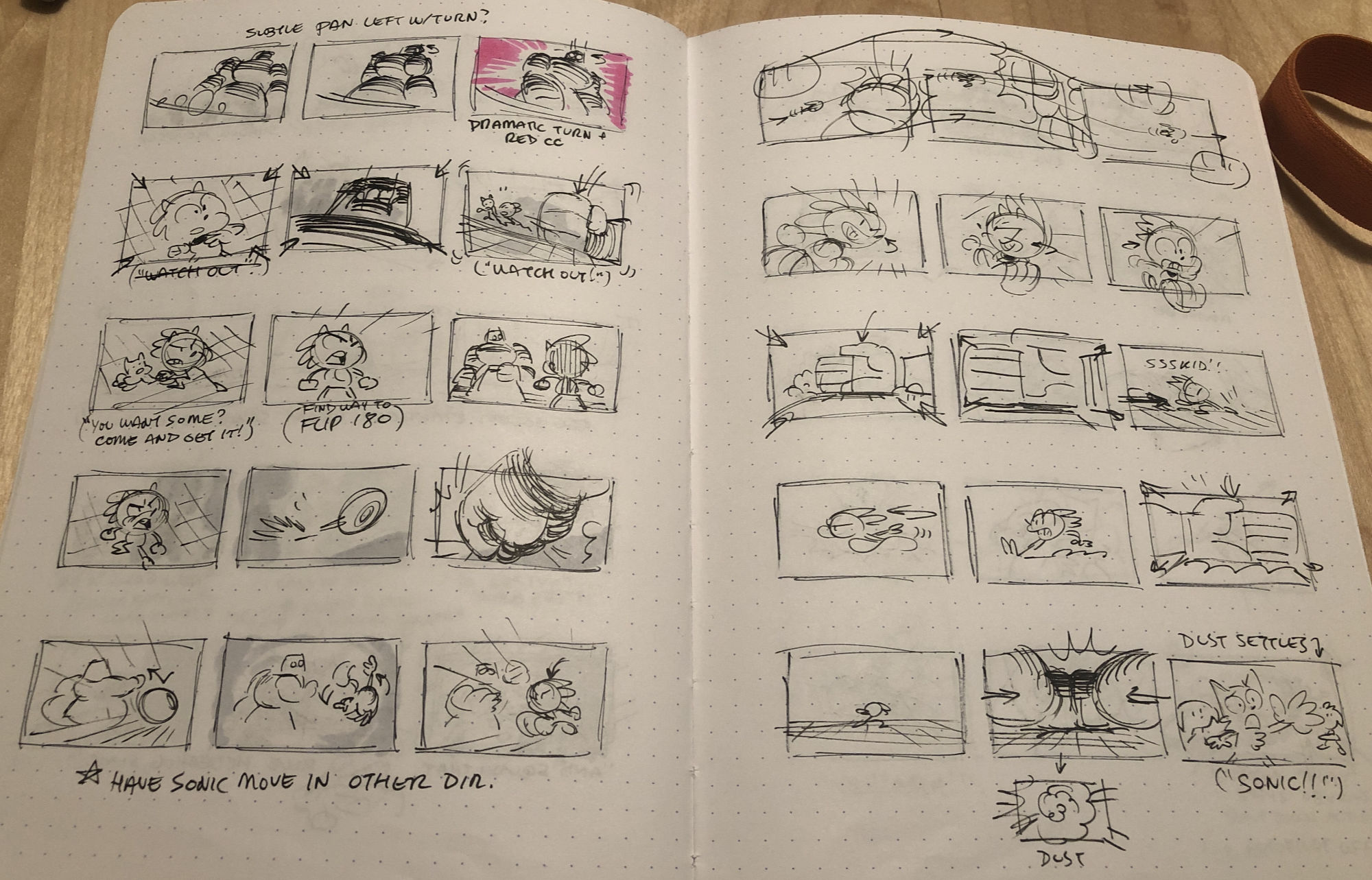
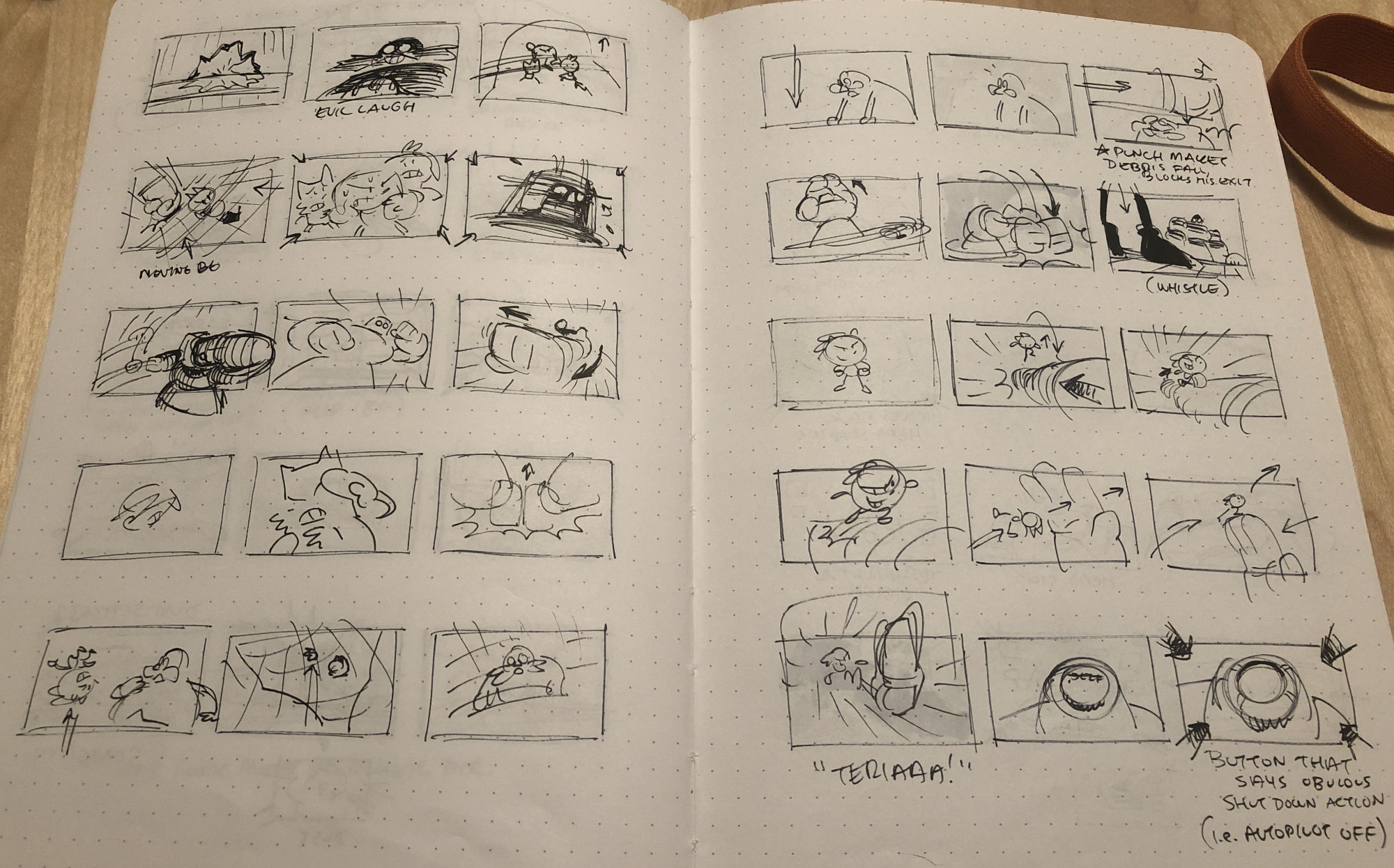
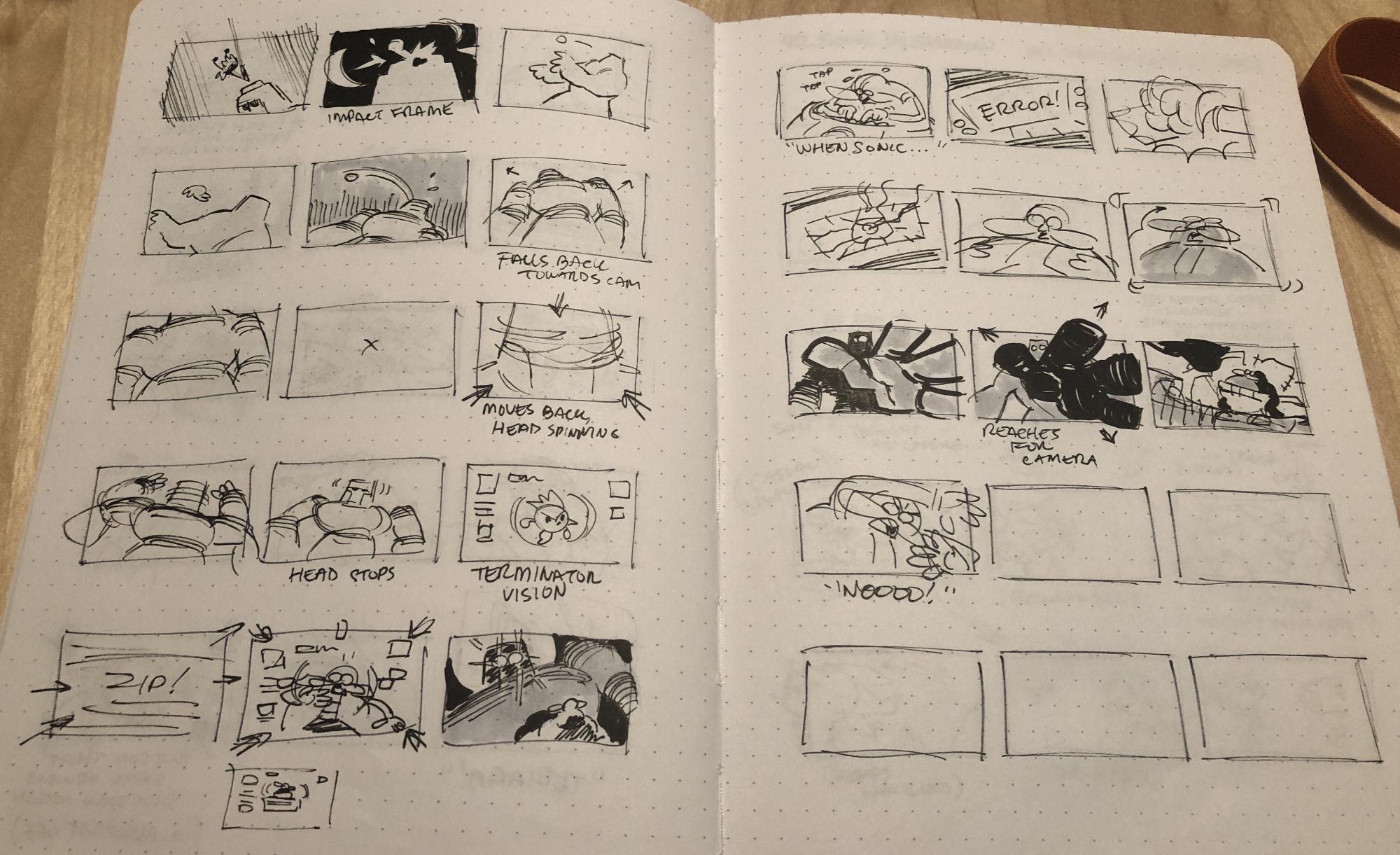
The nice thing is, most of these remained intact all the way to the end! These were drawn in May 2019, and I sent off my final file in December 2020. There were a lot of reviews and revisions I did on them, yet you can see the seeds of what would be the final sequence here! Now, all I have to do is boot up Storyboard Pro and start drawing out each panel digitally. There was also a movie premiere I saw in 2019 that blew my mind and inspired me to completely reboard a lot of my in-progress fight sequence… We'll get to that.
Throw It All Away
Now we’re storyboarding. This part comes in multiple stages. Usually I start by very roughly drawing out my thumbs again on the computer. This time I have a bigger canvas and a more accurate aspect ratio, so it’s easier for me to see and plan how the eye and action needs to move from shot to shot. I prioritize the key shots, getting them in, and then fill in the rest loosely. There is still room to move, change, or adjust things, so I don’t want to commit to things too early. As a cutscene, it’s very important to see how it plays, so I want to get some shot compositions in quickly, I want to start placing dialogue, and get a feel for the overall pacing.
You can see what I mean in this early export of the cutscene’s opening:
Most of the stuff here is very loose. I knew I wanted the closeup of Eggman’s eyes on “...as well as the Chaos Emeralds” for shot 21, and the rest of it was settling into position. I also used that scene to gauge how I wanted a finished shot to look, although this one had more dramatic lighting than usual.
The next phase was about getting all the action beats in. That was challenging! I probably have an earlier Storyboard Pro file or export of what it originally was, but I don’t want to pay the exorbitant monthly cost to open up a file, and I don’t have the motivation to dig back far enough for a blog post, so... yeah. And like I teased earlier, I also saw a movie that made me totally reassess my approach to boarding and staging action, and ended up restarting that whole sequence.
On August 1st, 2019, I went to go see the closing film of the Fantasia Film Festival: Promare.
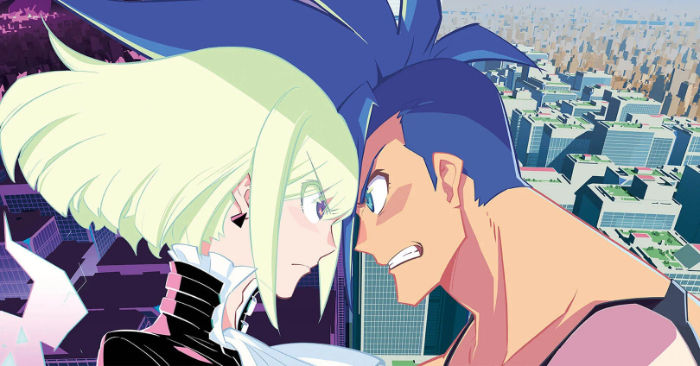
Let me tell you, the audience for this film was one of the ROWDIEST I've ever been to.
Listen. I couldn’t help but compare. I’m only human. In that moment, my work felt immensely flat. It shook me up in a good way, though. That movie really propelled me to study animation action more thoroughly, to really break down why that film worked the way it did. I learned one very important lesson that drastically improved my approach: as a storyboard artist, I wasn’t using my “camera” to its fullest potential.
By this, I mean that I wasn’t considering the ways that I can control the “lenses” being used, or the viewing angle depicted on screen. As a comparison, it’s like I was only swapping between a 35 and 50 mm lens, with most action set perpendicular to the characters on-screen. There was some distortion and perspective, but I wasn’t pushing it enough. I also wasn’t considering how the camera or action could move during the shot to help sell an movement more. As animators, we have incredible control over the position and movement of bodies, to help accentuate certain actions over others, and to motivate the camera’s movements. It's a critical tool in our toolbox!
With those ideas locked in, the rest of the sequence flowed smoothly. A lot of the work then was settling on the timing and figuring out how many new drawings I needed. Since this would be a public-facing animatic, I knew it needed more work. This is more of a very-low-quality animation since a lot more needs to be legible for a general audience. A good animatic, IMO, is one that leaves room for animators to interpret what’s on-screen while still guiding them in a loose direction. It should not guide moment-to-moment movement or require a perfect translation from page-to-screen unless it's for an absolutely critical reason. Good animatics don’t even need to be clean or on-model! As long as the core idea gets across, you’re good.
Fly in the Freedom
Like I said up top, I’m still incredibly proud of the work I did for this. This was my opportunity to make something for a game that really left its mark on me, among friends and acquaintances who felt similarly, all for the love of Sonic. I think back to April 2019, after I had just moved into a new place and started a new job, when Charlie came to visit me in Montréal, and we went to a café on Sherbrooke and Saint-Denis to talk about our respective parts, bounce ideas off each other, and draw (it also happened to be when the original Sonic movie trailer debuted, which was a wild time for other reasons). I knew this was a chance to do something cool and put it out into the world, for my friends and for myself. Little did we know how much the world would change by the time it was done.
When we finally got the go ahead to release our animatics, the internet was in a weird way. Cohost was already in a read-only state and was preparing for the end (RIP Eggbug). Everyone was pretty scattered around as Twitter slowly died, and I had no motivation to sign up for a new social media account to promote this. So… I just quietly uploaded it to Youtube and shared it with some friends. And I’m happy that it still managed to find some people, all of whom have left some really nice comments on it. So thank you!
I made it to be a part of something bigger, and for a while it was. I’m happy that it finally made its way out and that people are able to find it. This post is my way of giving it a proper send-off and to talk about all the hard work and care that went into bringing it to life.
TERIAAA!!
P.S. Here's a little something extra: when I originally signed up for the project, I put my name down for 2 scenes. The second one was the lead-up to the Sonic and Shadow battle that takes place at the end of the Hero Story, on the giant space platform. I got pretty far ahead with the thumbnail stage, but after exchanging ideas with Nat, I realized that this was going to be too big for me to take on in my free time in addition to finishing up the Egg Golem scene. I had to drop it and give up the scene so that someone else could try their hand at it, but let me tell you: we were really cooking with this one. I have Nat's thumbs saved still for the final sequence, and I had some BIG plans for the actual battle. In lieu of those, here are my script pages, thumbnail drawings, and an excerpt from the animatic during its early stages (this is what a true animatic should look like, by the way):
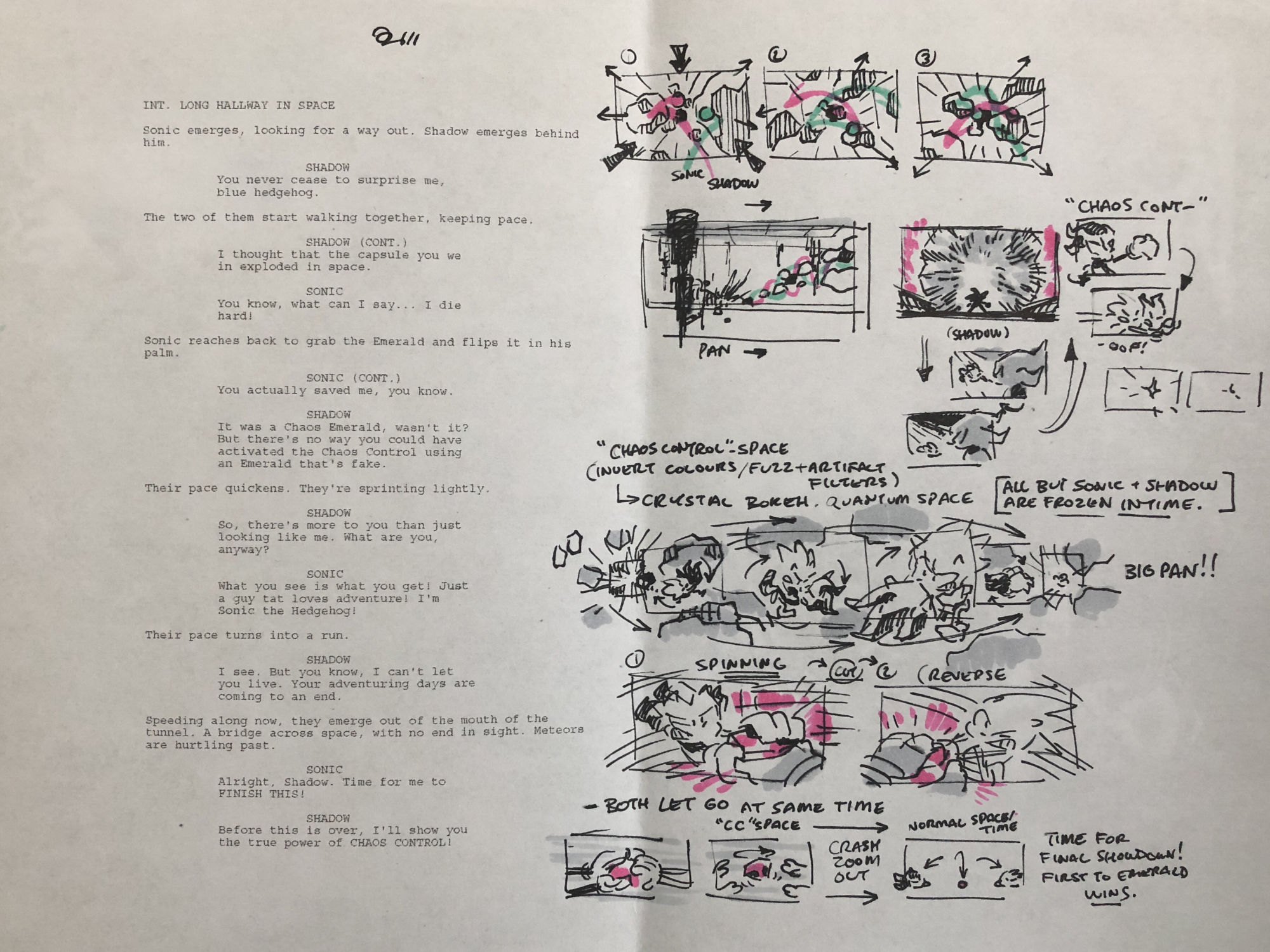
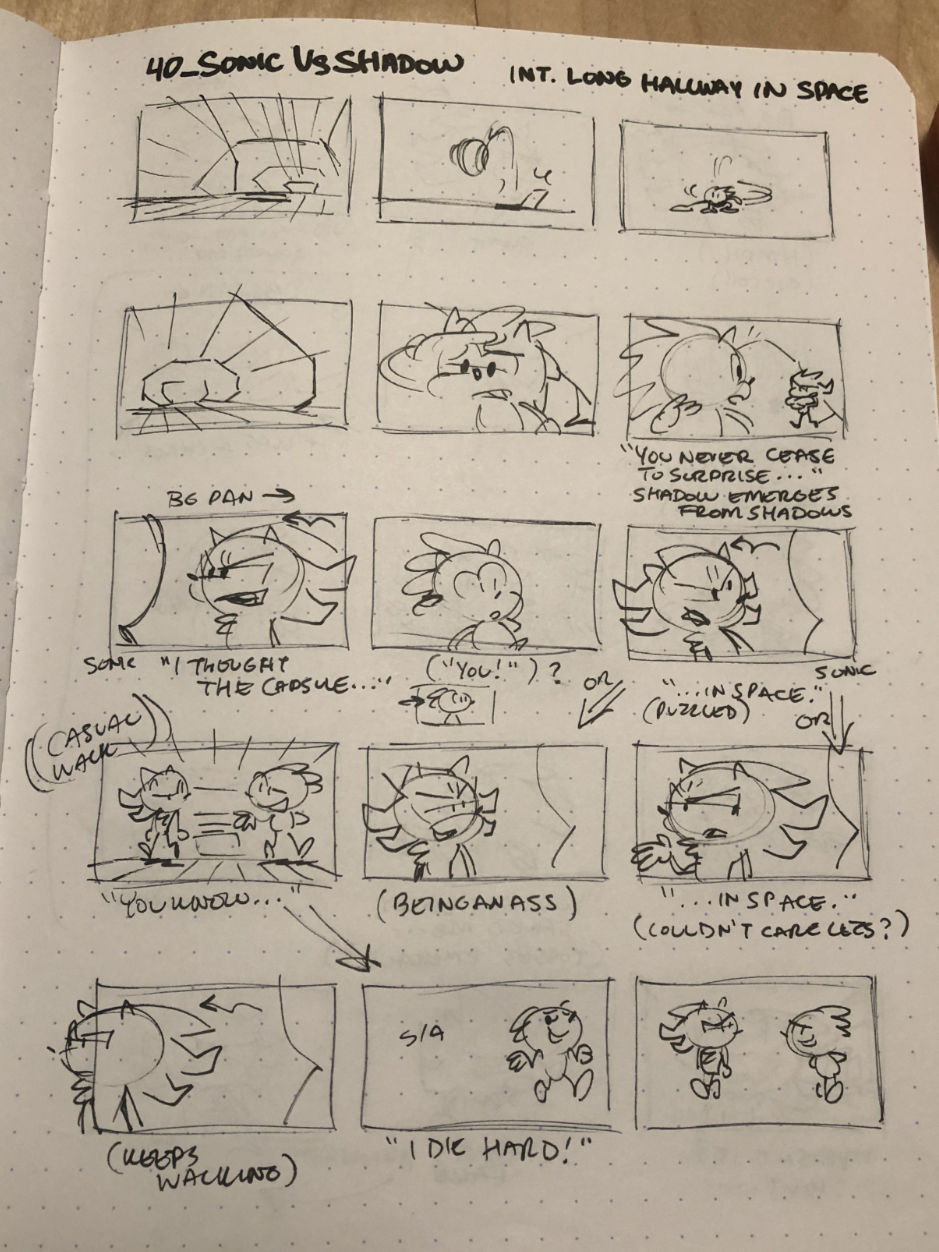
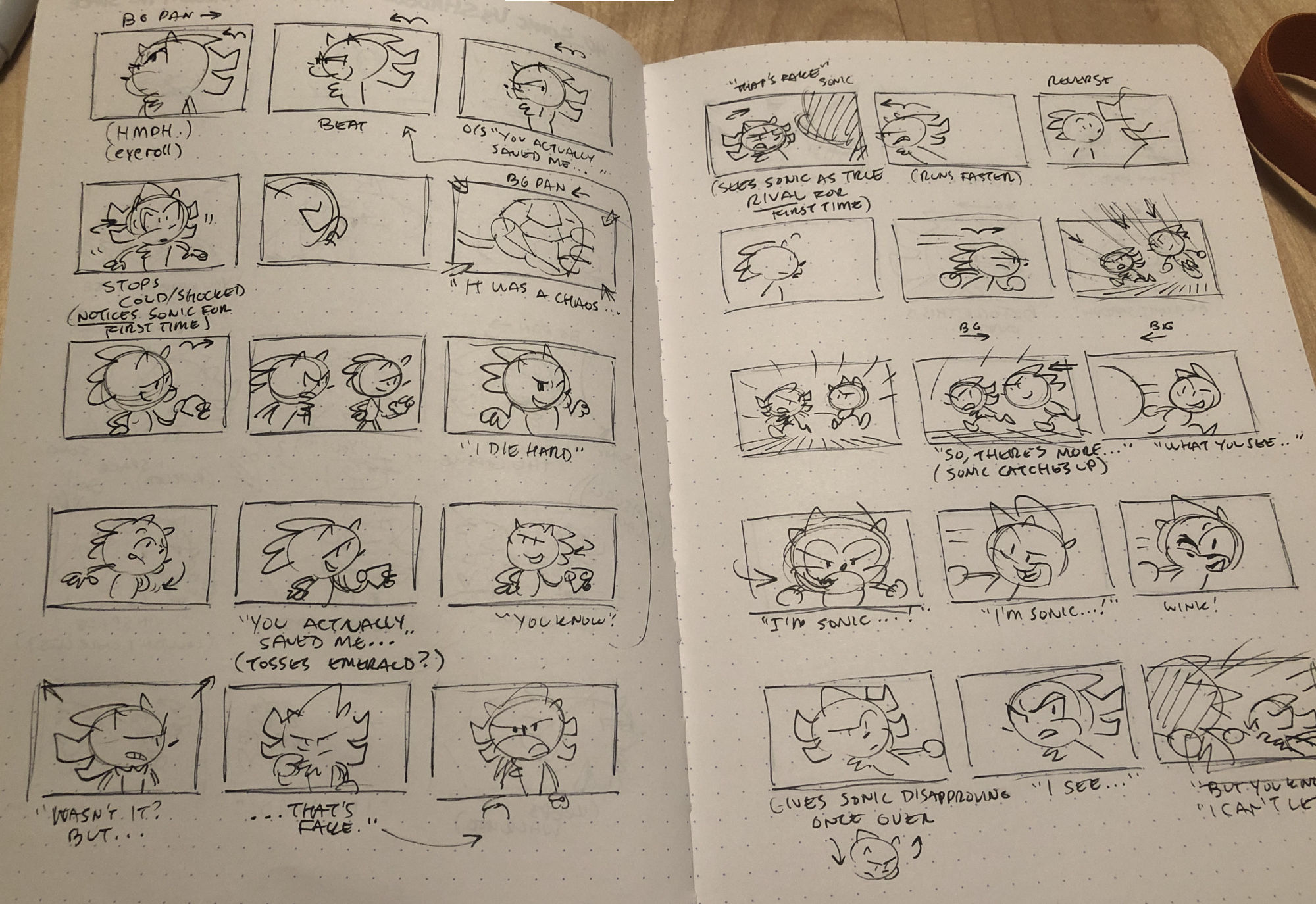
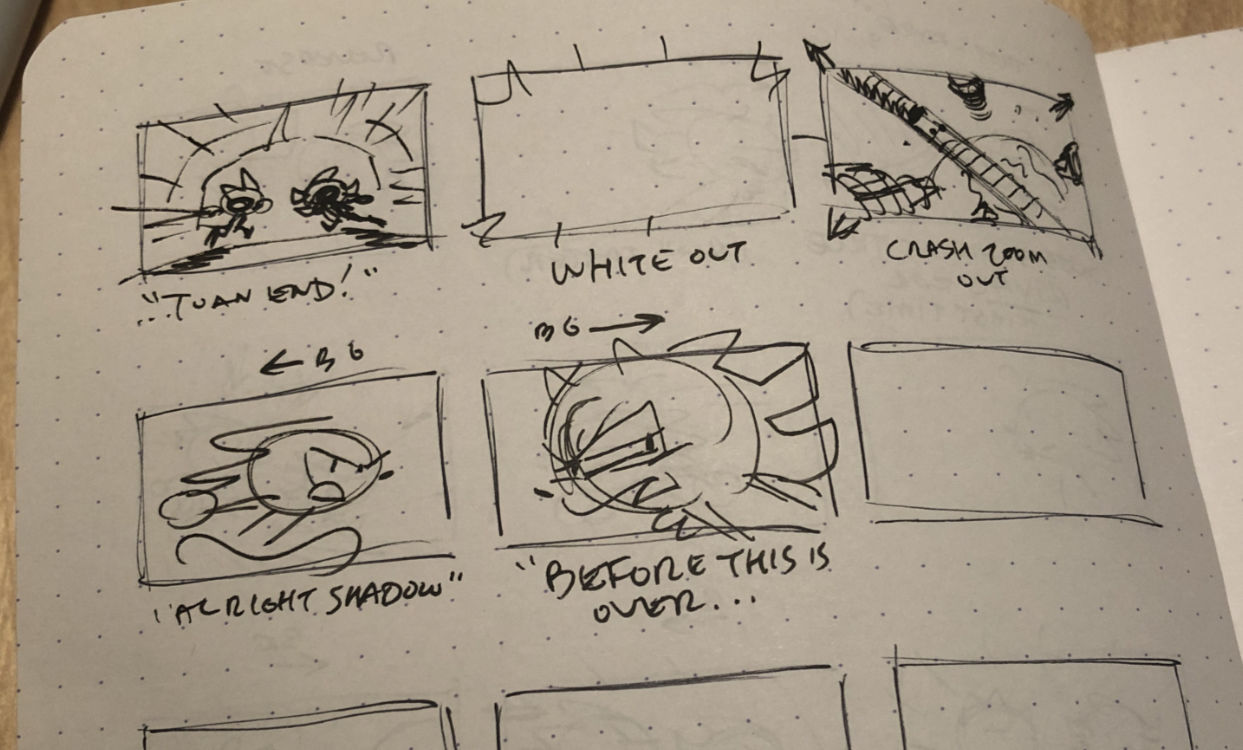
P.P.S. If there’s interest, maybe I can wrangle together a post on the non-narrative storyboard and animatic work I did on CONV/RGENCE: A League of Legends Story. A lot of it was during pre-production when we wanted a quick visual idea of, for example, how Ekko might move or attack, or later during production when we had to take another stab at crafting tension during the Warwick chase scene.
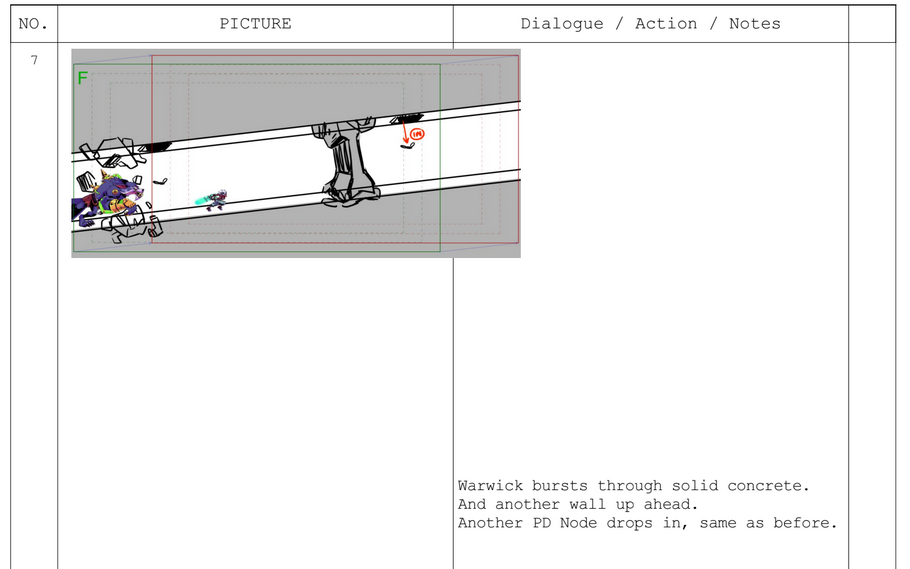
This was a tough sequence to crack! It's still one of my proudest contributions.